RRB NTPC Station Master Psycho Test – Complete Guide to Intelligence & Psychological Test Patterns (With Examples & Rules)

Jugal sir
AuthorRRB NTPC Station Master Psycho Test – Complete Guide to Intelligence & Psychological Test Patterns (With Examples & Rules)
Instruction for Pattern: intelligence
कुल प्रश्न = 35
Total Question = 35
समय = 10 मिनट
Time = 10 Minutes
Note:-
वास्तविक परीक्षा में प्रश्नों की संख्या एवं परीक्षा समय भिन्न हो सकता है।
The number of questions and exam time may vary in the actual exam.
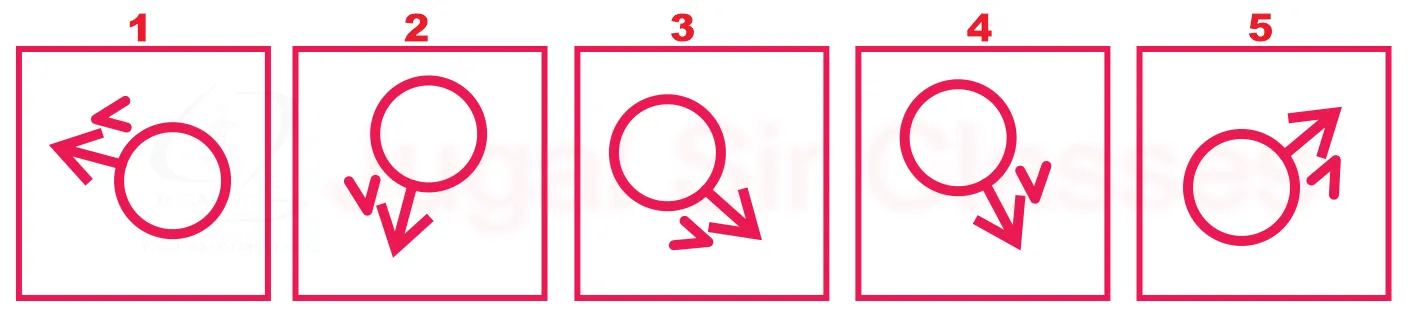
प्रत्येक प्रश्न में दी गयी आकृतियों में चार आकृतियाँ किसी रूप में अथवा किसी प्रकार से एक समान होती है, जबकि शेष आकृति चार आकृतियों से भिन्न होती है।
In each of the given figures, four figures are alike in some way or the other, while the rest of the figures are different from the other four figures.
उदाहरण (Example) :-
हल (Solution) :-
इस चित्र का उत्तर 4 होगा। क्योंकि इसी विकल्प में तीर के साथ नोंक बांयी ओर है बाकि सभी चित्र में नोंक तीर के दांयी ओर है।
The answer for this picture will be 4. Because in this option the tip of the arrow is on the left side whereas in all other pictures the tip is on the right side of the arrow.
Instruction for Pattern: selective_attention_even (Sectional)
कुल प्रश्न = 30
Total Question = 30
समय = 8 मिनट
Time = 8 Minutes
Note:-
वास्तविक परीक्षा में प्रश्नों की संख्या एवं परीक्षा समय भिन्न हो सकता है।
The number of questions and exam time may vary in the actual exam.
इस प्रकार के प्रश्नों में 15 से 20 अंक एक पंक्ति में दिये जाते हैं। जिनमें से सम अंकों का योग ज्ञात करना होता है। सम अंक 2, 4, 6, 8 होते हैं।
In this type of questions, 15 to 20 marks are given in a row. Out of which the sum of even marks has to be found. Even marks are 2, 4, 6, 8.
उदाहरण (Example) :-

हल (Solution) :-

Instruction for Pattern: selective_attention_odd (Sectional)
कुल प्रश्न = 30
Total Question = 30
समय = 8 मिनट
Time = 8 Minutes
Note:-
वास्तविक परीक्षा में प्रश्नों की संख्या एवं परीक्षा समय भिन्न हो सकता है।
The number of questions and exam time may vary in the actual exam.
इस प्रकार के प्रश्नों में 15 से 20 अंक एक पंक्ति में दिये जाते हैं। जिनमें से विषम अंकों का योग ज्ञात करना होता है। विषम अंक 1, 3, 5, 7, 9 होते हैं।
In this type of questions, 15 to 20 marks are given in a row. Out of which the sum of odd numbers has to be found. Odd numbers are 1, 3, 5, 7, 9.
उदाहरण (Example) :-

हल (Solution) :-

Instruction for Pattern: spatial_scanning (Sectional)
कुल प्रश्न = 40
Total Question = 40
समय = 8 मिनट
Time = 8 Minutes
Note:-
वास्तविक परीक्षा में प्रश्नों की संख्या एवं परीक्षा समय भिन्न हो सकता है।
The number of questions and exam time may vary in the actual exam.
इन प्रश्नों में 7 उर्ध्वाधर तथा 8 क्षेतिज रेखा परस्पर एक-दूसरे को काटते हैं, इन्हें रास्ता कहते हैं। रास्ते के मध्य अवरोधक को वृत्त (-o-) से प्रदर्शित किया जाता है, जिस पर से होकर गुजर नहीं सकते हैं। जहाँ दो रास्ते काटते हैं उसके किसी भी एक कोने पर वर्गाकार घर बनाकर उसमें रास्ते की संख्या 1 से 10 तक लिखा जाता है। अब जहाँ पर रास्ते समाप्त होते हैं वहाँ अंग्रेजी वर्णमाला के अक्षरों का प्रयोग किया जाता है। अब एक अक्षर से दूसरे अक्षर तक जाने का सर्वोत्तम रास्ता चुनना होता है।
In these questions, 7 vertical and 8 horizontal lines cross each other, these are called paths. The obstacle in the middle of the path is represented by a circle (-o-), which cannot be crossed. Wherever two paths cross, a square house is made on any one corner and the number of the path is written from 1 to 10. Now where the paths end, the letters of the English alphabet are used. Now the best path to go from one letter to the other has to be chosen.
नियम:-
1 - सबसे नजदीक का केवल एक ही रास्ता चुनें।
2 - रास्ते में जब स्टेशन से गुजरे तब कम से कम स्टेशन की एक दीवार या बगल स्पर्श करना अनिवार्य है।
3 - रास्ते में जब शुरूआत में जब ज्यादा अवरोधक आये तो पीछे की ओर मुड़कर छोटा रास्ता ढ़ूंढ़ने की कोशिश करें।
4 - यदि स्टेशन का केवल कॉर्नर स्पर्श है तो उसे नहीं गिना जाये।
5 - अवरोधक (-O-) से होकर नहीं गुजर सकते हैं।
6 - भूलवश इसे (O|O) प्रकार के बिन्दुओं को अवरोधक न समझें। यहां से आसानी से गुजरा जा सकता है।
7 - छोटे रास्ते में सबसे पहले विकर्णवत् सबसे छोटा रास्ता ढ़ूंढ़ने की कोशिश करें।
8 - छोटा रास्ता ढ़ूंढ़ते समय रास्ते में कम से कम मोड़ हो इस बात का ध्यान रखें।
9 - छोटे रास्ते के दौरान कम से कम एक स्टेशन से गुजरना अनिवार्य है और वही आपका उत्तर होगा।
10 - रूट टेस्ट में एकाग्रता का बहुत अधिक ध्यान रखा जाये।
Rule:-
1 - Choose only one nearest path.
2 - When passing through a station on the way, it is mandatory to touch at least one wall or side of the station.
3 - When there are many obstacles in the beginning of the path, turn back and try to find a shorter path.
4 - If the station only touches the corner, then it should not be counted.
5 - You cannot pass through the obstacle (-O-).
6 - Do not mistakenly consider these (O|O) type points as obstacles. One can easily pass through them.
7 - In the shortest path, first try to find the shortest diagonal path.
8 - While finding the shortest path, make sure that there are minimum turns in the path.
9 - It is mandatory to pass through at least one station during the shortest path and that will be your answer.
10 - Pay a lot of attention to concentration in the route test.
उदाहरण (Example) :-
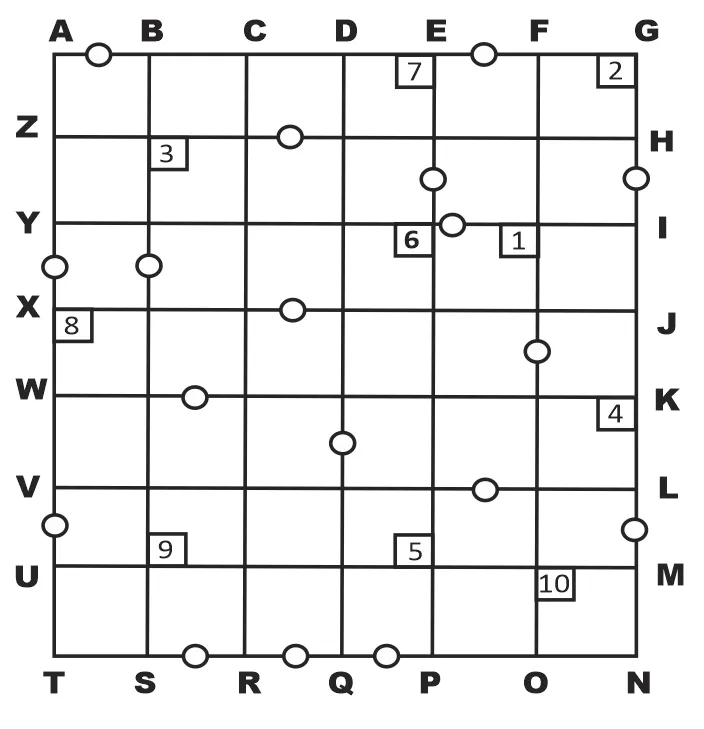
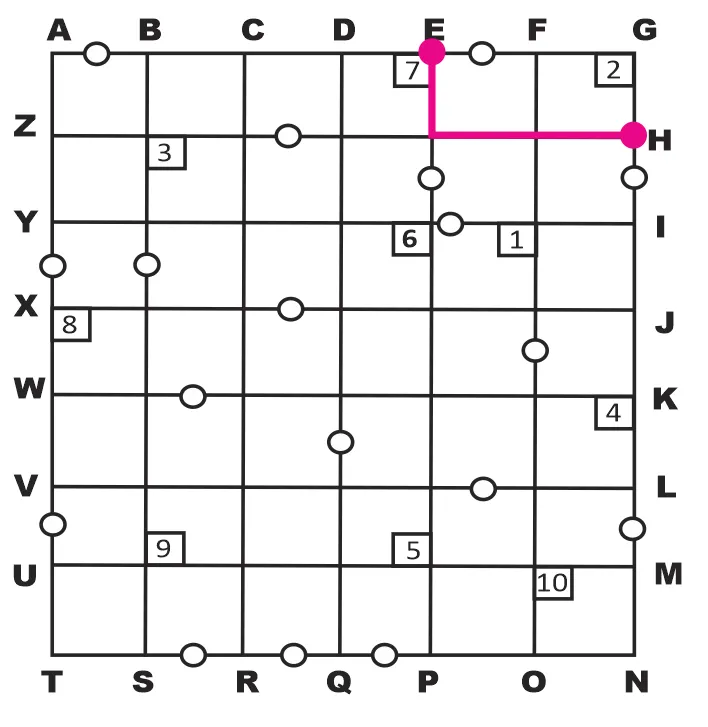
Question 1 - E to H
हल (Solution) :-
information_ordering_type1 (Sectional)
कुल प्रश्न = 25
Total Question = 25
समय = 12 मिनट
Time = 12 Minutes
Note:-
वास्तविक परीक्षा में प्रश्नों की संख्या एवं परीक्षा समय भिन्न हो सकता है।
The number of questions and exam time may vary in the actual exam.
इस प्रकार के प्रश्नों में वर्ग तथा वृत्त आकृति का प्रयोग किया जाता है।
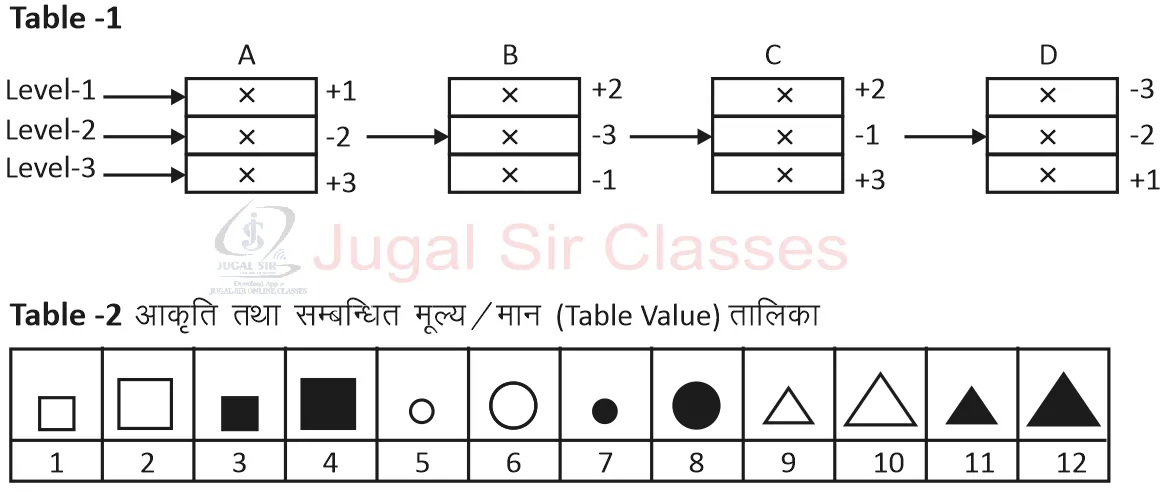
1. प्रश्नों को परीक्षण में दी गई तालिका 1 और तालिका 2 की सहायता से हल करना है।
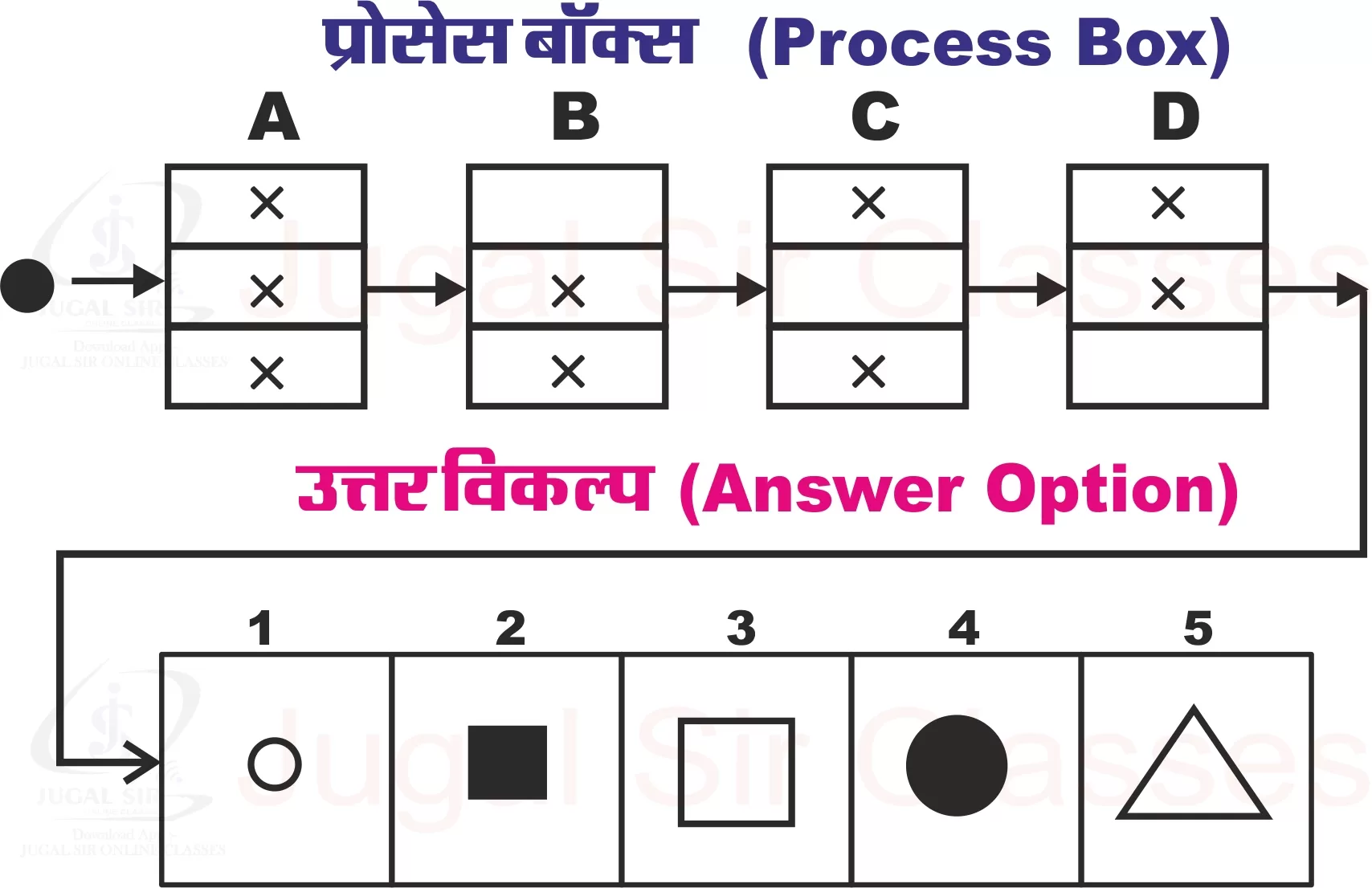
2. प्रत्येक प्रश्न में एक टेस्ट आकृति दी गई है।
3. प्रत्येक प्रश्न में एक सीरीज़ में A से D तक बॉक्स दिये गये हैं।
4. प्रत्येक प्रोसेस बॉक्स भी तीन भागों (लेवल) में विभाजित है जिसे 1, 2 और 3 नाम दिया गया है।
5. प्रत्येक स्तर में ‘X’ का चिन्ह होगा अथवा नहीं होगा।
6. जिस स्तर में ‘X’ का चिन्ह होगा उस स्तर में Table-1 के अनुसार अंको को जोड़ना अथवा घटाना होगा।
7. जिस स्तर में ‘X’ का चिन्ह नहीं होगा उस स्तर में कोई परिवर्तन नहीं होगा।
परीक्षण को नीचे दिये क्रम के अनुसार हल करें -
1. सर्वप्रथम टेस्ट आकृति का मूल्य, आकृति तालिका 2 से ज्ञात करें।
2. टेस्ट आकृति के मूल्य में (X) के चिन्ह वाले प्रत्येक प्रोसेस बॉक्स के A-D तक के स्तरों का मूल्य जोड़े अथवा घटायें।
3. प्रोसेस बॉक्स D के अन्तिम स्तर में प्राप्त संख्या के मूल्य से संबंधित आकृति, आकृतिक तालिका 2 से ज्ञात करें।
4. प्राप्त आकृति से संबंधित उत्तर विकल्प को चुनें।
Trick 1 - यदि ब्लॉक खाली मिलें तो हमें उसमें किसी भी प्रकार का जोड़ या घटाव नहीं करना है।
Trick 2 - यदि टेबल-1 में लगातार -, - या +, + आये तो उन्हें एक साथ ही जोड़ लें।
Trick 3 - टेबल में जोड़ या घटाव करते समय एवं या और शब्दों का प्रयोग न करते हुए जोड़ व घटायें।
Trick 4 - इसमें एकाग्रता व लगातार अभ्यास की अति आवश्यकता है।
In this type of questions, square and circle shapes are used.
1. The questions have to be solved with the help of Table 1 and Table 2 given in the test.
2. A test shape is given in each question.
3. In each question, boxes from A to D are given in a series.
4. Each process box is also divided into three parts (levels) which are named 1, 2 and 3.
5. Each level will either have a symbol of ‘X’ or it will not.
6. In the level in which there is a symbol of ‘X’, the digits have to be added or subtracted according to Table-1.
7. In the level in which there is no symbol of ‘X’, there will be no change.
Solve the test in the order given below –
1. First of all, find the value of the test shape from Table 2.
2. Add or subtract the value of levels A-D of each process box marked with (X) to the value of the test figure.
3. Find the figure related to the value of the number obtained in the last level of process box D from figurative table 2.
4. Choose the answer option related to the figure obtained.
Trick 1 - If the block is found empty, then we do not have to do any kind of addition or subtraction in it.
Trick 2 - If -, - or +, + appear continuously in Table-1, then add them together.
Trick 3 - While doing addition or subtraction in the table, do addition and subtraction without using the words or and.
Trick 4 - Concentration and continuous practice is very necessary in this.
उदाहरण (Example) :-
Question
हल (Solution) :-
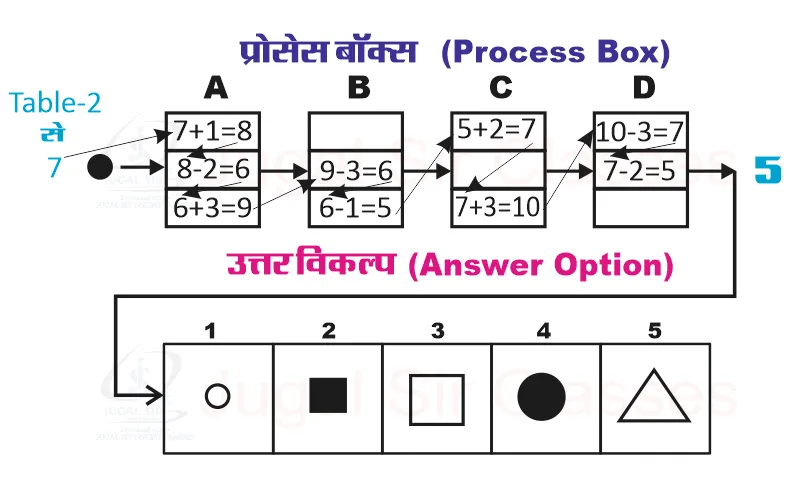
अतः 5 नम्बर को टेबल-2 की 5 नंबर आकृति से मिलान करने पर जो आकृति निकल कर आती है उस आकृति से उत्तर 2 होगा।
Therefore, when we match number 5 with figure 5 of Table-2, the answer that comes out will be 2.
information_ordering_type2 (Sectional)
कुल प्रश्न = 25
Total Question = 25
समय = 12 मिनट
Time = 12 Minutes
Note:-
वास्तविक परीक्षा में प्रश्नों की संख्या एवं परीक्षा समय भिन्न हो सकता है।
The number of questions and exam time may vary in the actual exam.
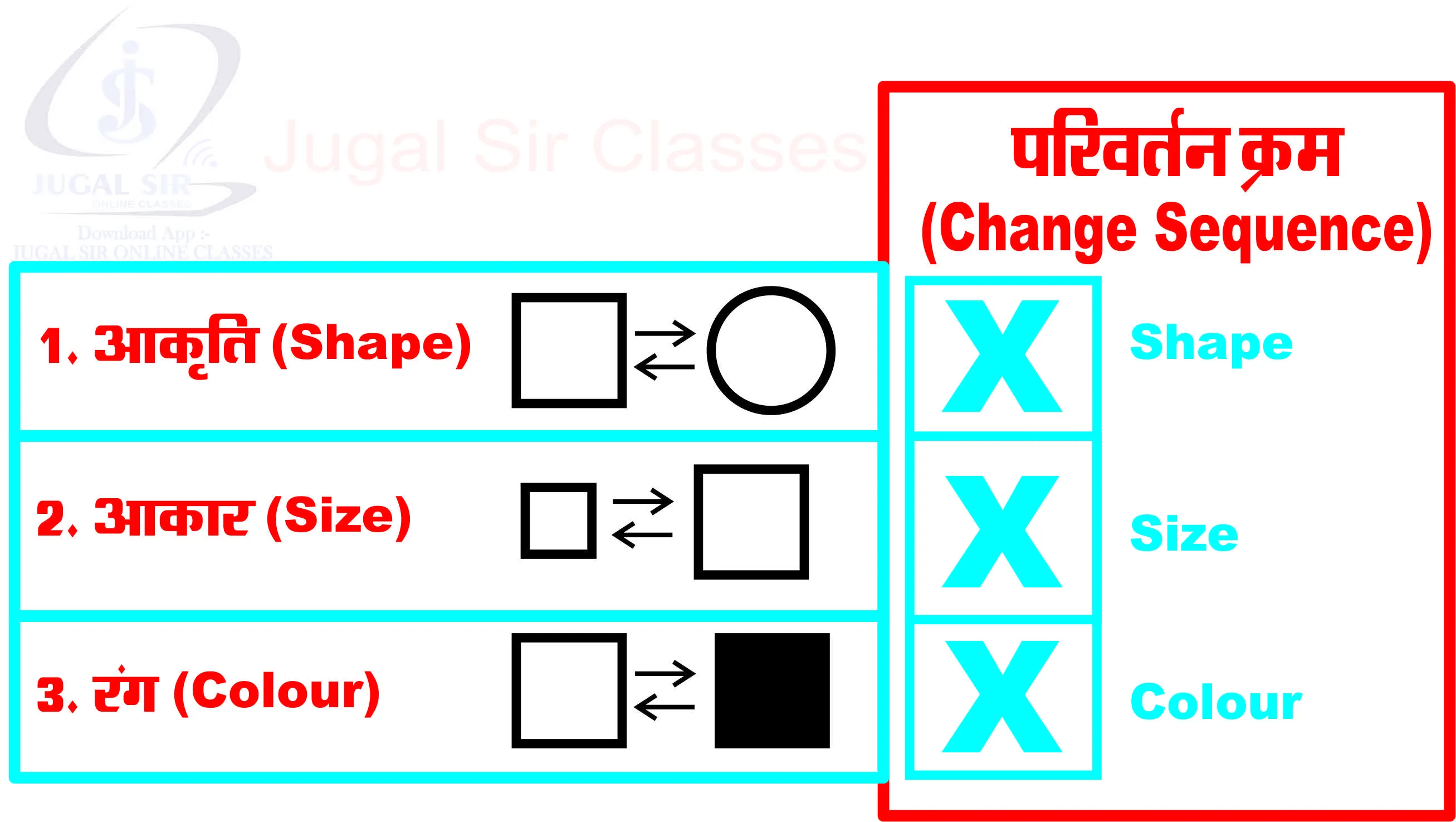
इस प्रकार के प्रश्नों में वर्ग तथा वृत्त आकृति का प्रयोग किया जाता है। जिनमें तीन प्रकार का परिवर्तन होता है –
In these types of questions, square and circle shapes are used. In which three types of changes take place –
आकृति (Shape), आकार (Size) व रंग (Colour)।
इस प्रकार के प्रश्नों में चार विकल्प (A, B, C, D) बॉक्स के रूप में होते हैं और चित्र में केवल एक परिवर्तन होगा या फिर कोई परिवर्तन नहीं होगा।
In this type of questions there are four options (A, B, C, D) in the form of boxes and there will be only one change in the picture or there will be no change.
उदाहरण (Example) - 1 :-
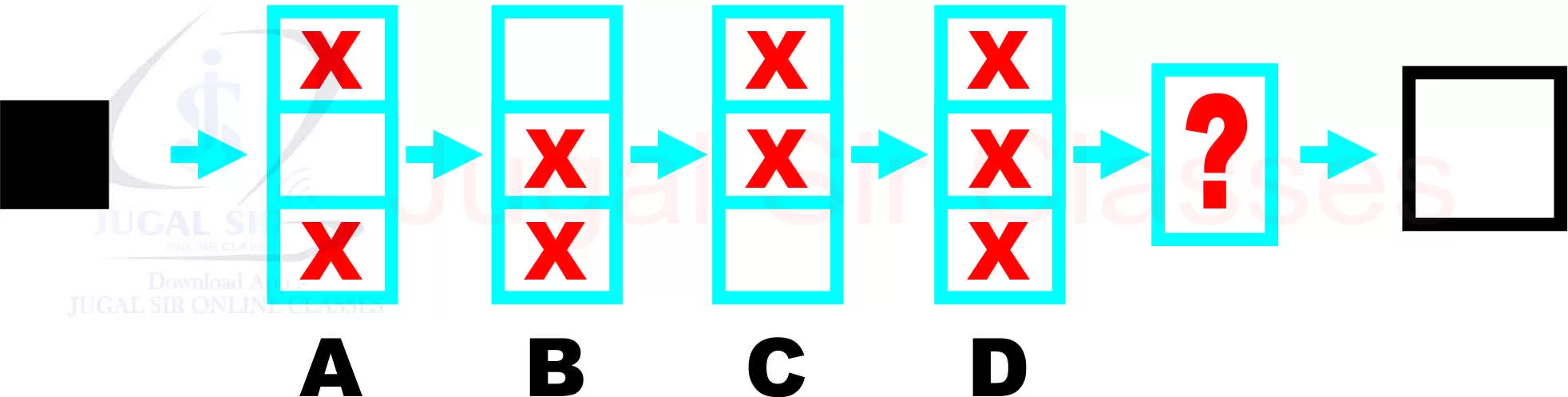
हल (Solution) :-
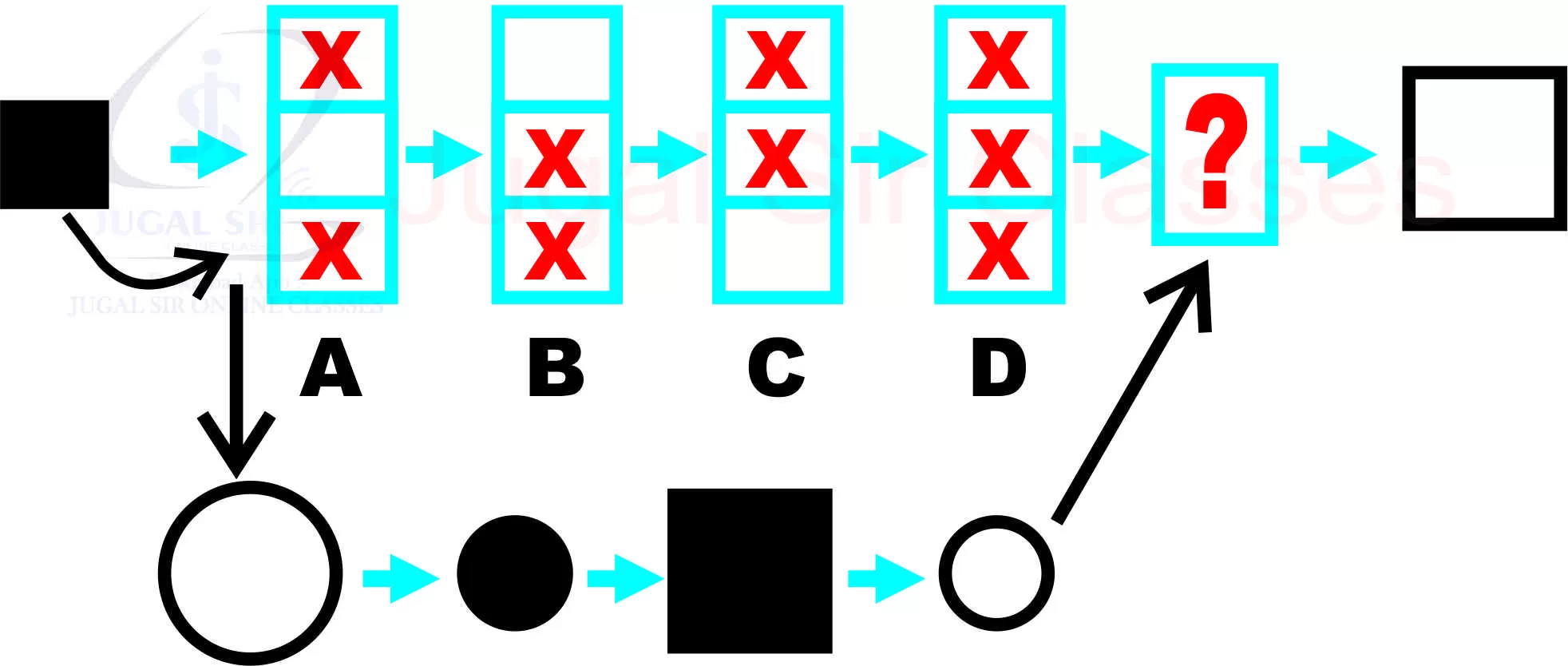
यहाँ बायीं ओर दी गई आकृति को विकल्प A द्वारा बदल देने पर आकृति व रंग बदल जाता है।
➝ इस प्रकार हमें सफेद बड़ा वृत्त प्राप्त होता है।
The given figure on the left, when changed by option A, changes its Shape & color.
➝ Thus, we get a large white circle.
अब बड़े वृत्त को विकल्प B द्वारा बदल देने पर आकार और रंग बदल जाता है।
➝ इस प्रकार हमें छोटा काला वृत्त प्राप्त होता है।
Now, when this large circle is changed by option B, its shape and color both change.
➝ Thus, we get a small black circle.
अब छोटे काले वृत्त को विकल्प C द्वारा बदल देने पर आकृति और आकार बदल जाता है।
➝ इस प्रकार हमें बड़ा काला वर्ग प्राप्त होता है।
Next, when the small black circle is changed by option C, the figure and shape change.
➝ Thus, we get a large black square.
इसी प्रकार बड़े काले वर्ग को विकल्प D द्वारा बदल देने पर आकृति, आकार, रंग सब बदल जाता है।
➝ इस प्रकार हमें छोटा सफेद वृत्त प्राप्त होता है।
Similarly, when the large black square is changed by option D, the figure, shape, and color all change.
➝ Thus, we get a small white circle.
इसी प्रकार दिए गए आकृति के चारों परिवर्तन नियमों के अनुसार आकृतियों का रूप बदलता है।
In this way, according to the four transformation rules, the figures keep changing their forms.
इन चारों विकल्पों (A, B, C, D) के माध्यम से आकृति का चार बार परिवर्तन करके, पाँचवें आकृति का सही उत्तर निकालना होता है।
By applying all four options (A, B, C, D) in sequence, we can transform the given figure four times and find the correct fifth figure.
यहाँ छोटे सफेद वृत्त को बड़े सफेद वर्ग में बदलने के लिए विकल्प C सही नियम को दर्शा रहा है।
➝ इसलिए सही उत्तर है: विकल्प C।
Here option C represents the correct rule to convert the small white circle into a big white square.
➝ Therefore, the correct answer is: Option C.
information_ordering_type3 (Sectional)
कुल प्रश्न = 25
Total Question = 25
समय = 12 मिनट
Time = 12 Minutes
Note:-
वास्तविक परीक्षा में प्रश्नों की संख्या एवं परीक्षा समय भिन्न हो सकता है।
The number of questions and exam time may vary in the actual exam.
इस प्रकार के प्रश्नों में वर्ग तथा वृत्त आकृति का प्रयोग किया जाता है। जिनमें तीन प्रकार का परिवर्तन होता है –
In these types of questions, square and circle shapes are used. In which three types of changes take place –
आकृति (Shape), आकार (Size) व रंग (Colour)।
इस प्रकार के प्रश्नों में तीन विकल्प (A, B, C) बॉक्स के रूप में होते हैं और चित्र में दो प्रकार के परिवर्तन होंगे।
In this type of questions there are three options (A, B, C) in the form of boxes and there will be two types of changes in the picture.
उदाहरण (Example) - 1 :-
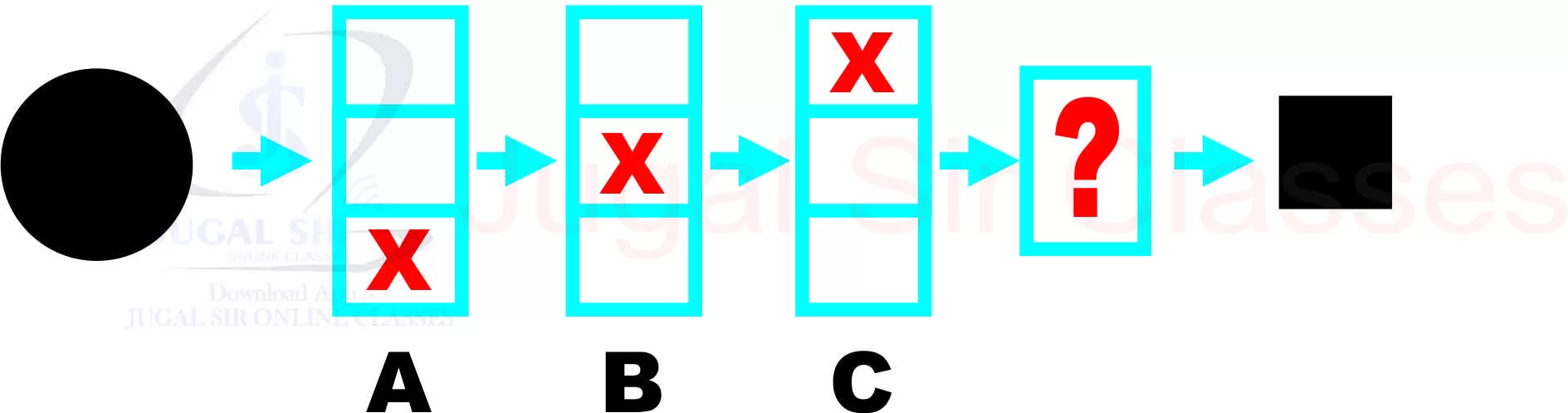
हल (Solution) :-
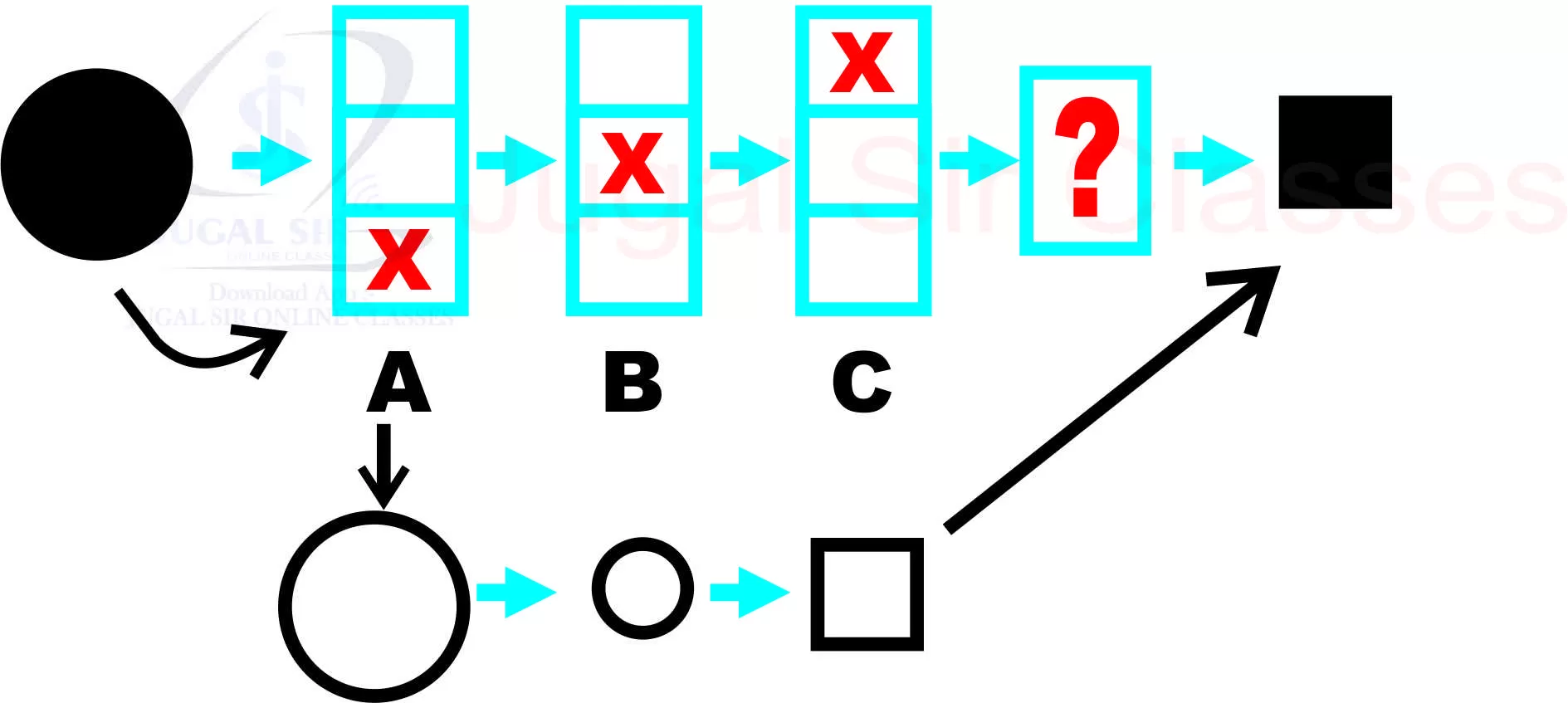
यहाँ बायीं ओर दी गई आकृति को विकल्प A द्वारा बदल देने पर रंग बदल जाता है।
➝ इस प्रकार हमें सफेद बड़ा वृत्त प्राप्त होता है।The given figure on the left, when changed by option A, changes its color.
➝ Thus, we get a large white circle.अब सफेद बड़े वृत्त को विकल्प B द्वारा बदल देने पर आकार बदल जाता है।
➝ इस प्रकार हमें छोटा सफेद वृत्त प्राप्त होता है।Now, when the large white circle is changed by option B, its shape changes.
➝ Thus, we get a small white circle.अब छोटे सफेद वृत्त को विकल्प C द्वारा बदल देने पर आकृति बदल जाती है।
➝ इस प्रकार हमें छोटा सफेद वर्ग प्राप्त होता है।Next, when the small white circle is changed by option C, the figure changes.
➝ Thus, we get a small white square.इसी प्रकार छोटे सफेद वर्ग को छोटे काले वर्ग में बदलने के लिए इन दोनों के मध्य क्रमिक परिवर्तन करने होंगे।
➝ उसके आधार पर तीनों आकृतियों में से सही विकल्प को चुनकर उत्तर प्राप्त करना है।Similarly, to convert a small white square into a small black square, sequential changes will have to be made between the two.
➝ Based on that, the correct option must be chosen from the given figures.यहाँ छोटे सफेद वर्ग को छोटे काले वर्ग में बदल रहा है,
➝ इसका मतलब सही परिवर्तन केवल विकल्प A सही बदलने के नियम को दर्शा रहा है।Here, the small white square changes into a small black square.
➝ That means only Option A correctly shows the rule of transformation.अतः: विकल्प A सही उत्तर होगा।
Therefore, Option A is the correct answer.
personality (Sectional)
कुल प्रश्न = 35
Total Question = 35
समय = 10 मिनट
Time = 10 Minutes
Note:-
वास्तविक परीक्षा में प्रश्नों की संख्या एवं परीक्षा समय भिन्न हो सकता है।
The number of questions and exam time may vary in the actual exam.
इस प्रकार के प्रश्नों को बनाते समय एक आदर्श व्यक्ति की परिकल्पना का सहारा लिया जाता है। आपका व्यक्तित्व उस काल्पनिक आदर्श व्यक्ति के व्यक्तित्व के जितने समान होगा। आपके इस परीक्षण में सफल होने की संभावना उतनी ही अधिक होगी।
While making such questions, the imagination of an ideal person is used. The more similar your personality is to that imaginary ideal person, the greater will be your chances of succeeding in this test.


Discussion (0)
No comments yet. Be the first to share your thoughts!